
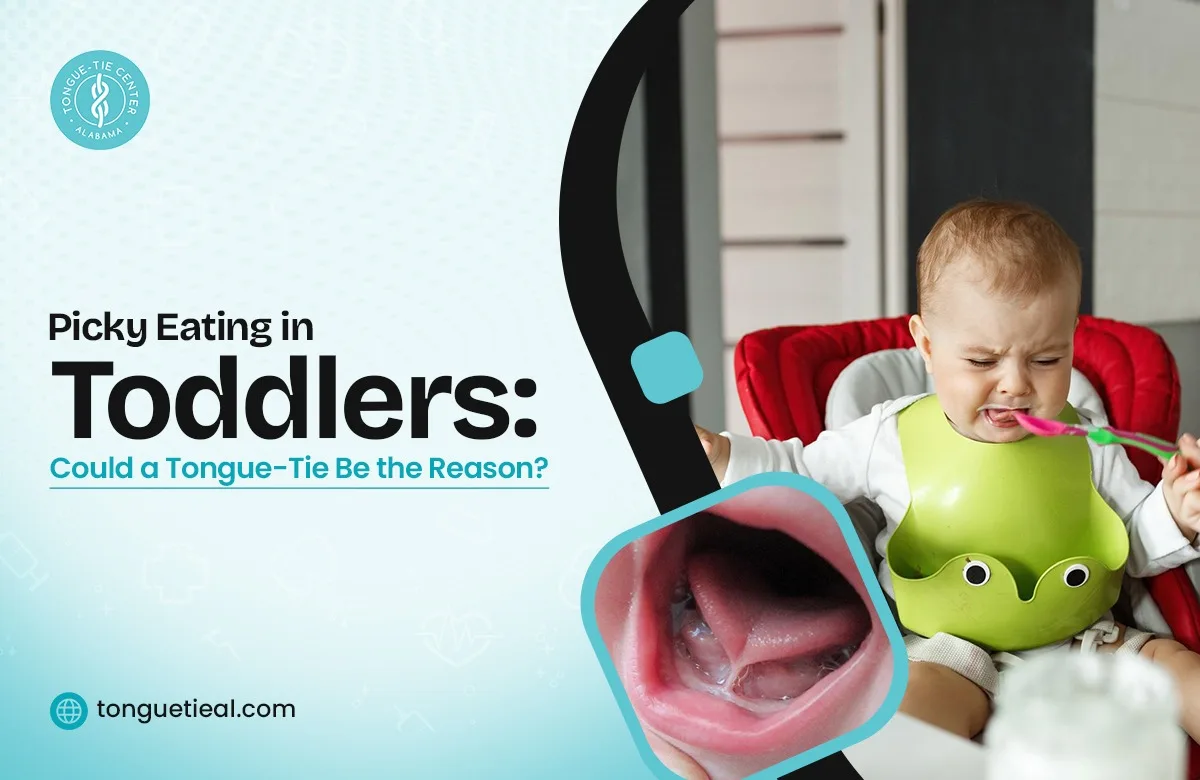
Quick Answer: Picky eating in toddlers is common, but persistent feeding difficulties may sometimes be linked to limited tongue movement. A tongue-tie can make it harder for some children to move food around the mouth, chew certain textures, or swallow comfortably. Signs may include gagging, very slow eating, pocketing food in the cheeks, spitting food out, or avoiding certain textures. However, picky eating can have many causes, so a proper evaluation is important before deciding whether a tongue-tie is contributing to the problem.
Almost every parent of a toddler has been told the same thing at some point: “They’re just a picky eater. They’ll grow out of it.”
And a lot of the time, that’s true. Toddlers have opinions, and food is one of the few things they get to control.
But some families come to us after months or even years of stressful mealtimes. Their child gags on certain textures, eats painfully slowly, spits food out, or seems to live on crackers and yogurt. They’ve tried every trick, and nothing sticks. For some of these kids, picky eating in toddlers isn’t only about preference. The tongue may not be moving the way it needs to.
In this post, I’ll walk through how a tongue-tie can affect eating, the signs I look for in toddlers and older kids, and what you can do if you’re worried about your child.
Why Picky Eating in Toddlers Isn’t Always “Just a Phase”
Eating seems simple, but it’s actually a lot of work for the mouth. The tongue has to move food around, push it over to the teeth to be chewed, gather it back up, and then move it to the back of the mouth to swallow. That takes a lot of lifting, side-to-side motion, and coordination.
What the Tongue Does During Chewing and Swallowing
When a child takes a bite of chicken, the tongue has to move that food onto the back teeth, keep it there while the child chews, then collect all the little pieces into a ball and swallow it. If the tongue is held down by a tight string of tissue underneath (the frenum), those movements get harder. The child may still manage, but it takes more effort, more time, and sometimes more gagging.
How a Restricted Tongue Changes Mealtime
Kids are smart. If a food is hard for them to manage, they avoid it. So a child with a restricted tongue will often stick to foods that are easy to handle, like crunchy snacks that dissolve, smooth purees, or foods they can swallow without much chewing. From the outside, it looks like pickiness. From the inside, it’s often a child protecting themselves from a food that is hard to eat.
Many of these kids had feeding trouble as babies too, like difficulty nursing or taking a bottle. When they moved to solid foods, they may have choked, gagged, or struggled with certain textures. Those issues can carry right on into the toddler and school-age years.
Is Mealtime a Struggle?
Find Out If a Tongue-Tie May Be Affecting Your Child’s Eating
Signs a Tongue-Tie May Be Behind Your Child’s Picky Eating
No single sign means your child has a tongue-tie. It’s the overall picture that matters. But these are the feeding issues we see most often in toddlers and older children with a tongue restriction.
Feeding Signs at the Table
-
Very slow eating, or trouble finishing a meal
-
Only eating small amounts of food
-
Pickiness with textures, especially meats and soft, mushy foods (like mashed potatoes)
-
Choking or gagging on foods or liquids
-
Spitting food out
-
Packing food in the cheeks like a chipmunk
-
A long history of feeding trouble, starting with nursing or bottle-feeding
Other Clues Outside of Mealtime
A tongue-tie rarely affects just one thing. Parents are often surprised when I ask about speech and sleep during a feeding visit. Other clues include:
-
Speech that is delayed, mumbled, or hard to understand
-
Snoring, restless sleep, or grinding teeth at night
-
Sleeping with the mouth open or breathing through the mouth during the day
-
Thumb sucking or long-term pacifier use
-
Not being able to touch the roof of the mouth with the tongue when opening wide
If you’re seeing several of these, it’s worth taking a closer look. You can also try our quick symptom quiz or look over our Child Assessment Sheet. If you have more than a few checkmarks, an evaluation is a good idea.
Other Reasons Kids Can Be Picky Eaters
I want to be honest here. Not every picky eater has a tongue-tie, and a tongue-tie release isn’t the answer for every feeding problem.
Picky eating can also be related to normal toddler development, sensory differences, reflux or other medical issues, enlarged tonsils, or behavior patterns that build up around stressful mealtimes. That’s why we always start with a full history and exam, not just a quick look under the tongue.
If a child has one or two mild feeding quirks and the tongue moves well, there’s usually nothing to do. If it ain’t broke, don’t fix it. But if the tongue is restricted and the child has a lot of these symptoms, that’s when a release can really help.
It’s also worth checking with your pediatrician if your child isn’t growing well, is losing weight, or is choking often. Those always need attention.
How a Tongue-Tie Is Checked in Toddlers and Older Kids
Checking a toddler for a tongue-tie is different from checking a baby, and it’s different from how most people were taught.
Why “Stick Out Your Tongue” Isn’t Enough
Asking a child to stick out their tongue is one of the worst ways to check for a tie. The key measure is how well the tongue lifts. Many kids with a restricted tongue can stick it out just fine, but they can’t lift it to the roof of the mouth. Some of the ties that cause the most trouble are less obvious ones that sit further back under the tongue, often called a posterior tongue-tie. These are commonly missed.
What We Look For at the Consult
At the Alabama Tongue-Tie Center, a consult includes a questionnaire, a conversation about your child’s history, a full exam, and photos if we find a restriction. I’ll look at how high the tongue lifts, where the frenum attaches, and how much tension there is. Then we talk through how those findings fit with what you’re seeing at home. There’s no pressure. If I don’t think a tongue-tie is the problem, I’ll tell you.
What Happens If Your Child Needs a Release
If a release makes sense, we can usually do it the same day as the consult. We use a CO2 laser, and the release itself takes about 10 to 15 seconds, usually with minimal or no bleeding. We don’t use sedation or general anesthesia. Older kids get a strong topical numbing jelly, and some older kids get a little extra numbing medicine as well. Most kids head out to play on our playground afterward.
After the release, you’ll do quick stretches at the release site 2 times a day for 4 weeks, starting the day after the release, and we’ll see you back in one week to check healing.
Feeding Therapy After the Release
A release gives the tongue room to move, but your child still has to learn how to use it. For kids who have been eating one way for years, that takes practice. Working with a feeding therapist or speech therapist can make a big difference, and for children over 4, we often recommend myofunctional therapy. We don’t provide therapy in our office, but we’re happy to work with your child’s therapist so everyone is on the same page. You can read more about that on our pediatric speech and feeding therapy page.
When the tongue can move well, therapy often goes faster and feels easier for the child. In our 2020 study published in Clinical Pediatrics (Baxter et al., 2020), parents reported that solid feeding improved in 83% of children after a tongue-tie release paired with exercises.
Frequently Asked Questions
Q1. Is picky eating in toddlers normal?
Some picky eating is a normal part of being a toddler. It’s more concerning when a child gags often, eats very slowly, avoids whole groups of textures like meat, or has had feeding trouble since infancy. Those patterns are worth an evaluation.
Q2. Can a tongue-tie cause gagging on food?
Yes, it can. A restricted tongue has a harder time moving food around and forming it into a ball to swallow, so some kids gag or choke on certain textures. Gagging can have other causes too, so a full evaluation is important.
Q3. Is my child too old to have a tongue-tie treated?
We treat children from as early as one day old up to age 18. It’s easier to fix feeding habits earlier, but older kids can still benefit, especially when a release is paired with therapy.
Q4. Do I need a referral to have my child checked?
No referral is needed. You can call us or send us a message to set up a consult.
Q5. Will my child need feeding therapy after a release?
Many kids do benefit from feeding therapy or myofunctional therapy after a release, especially if they’ve been eating around a restriction for a long time. We’ll talk through what makes sense for your child.
Continue Reading
Tired of Mealtime Battles? We Can Help.
You know your child better than anyone. If mealtimes feel harder than they should, trust that instinct. You’re not crazy, and you’re not a bad parent because your child won’t eat meat.
We see families from Birmingham, all over Alabama, and beyond. Our office is at 2480 Pelham Pkwy in Pelham, just south of Birmingham, and we’re open Monday through Friday, 8:00 a.m. to 4:30 p.m. Send us a message or call us at 205-419-4333 to schedule a consult. We’ll take the time to listen, do a thorough exam, and help you figure out whether a tongue-tie is part of the picture.
References
Baxter R, Merkel-Walsh R, Baxter BS, Lashley A, Rendell NR. Functional Improvements of Speech, Feeding, and Sleep After Lingual Frenectomy Tongue-Tie Release: A Prospective Cohort Study. Clin Pediatr (Phila). 2020;59(9-10):885-892. doi:10.1177/0009922820928055. PMID: 32462918.

Worried About Your Child’s Eating?