Quick Answer: Regular snoring in children is not normal. Common causes of child snoring include large tonsils and adenoids, allergies, and a narrow palate. A tongue-tie can also keep the tongue low, causing mouth breathing and a narrower airway at night. An exam can find the real cause.
A lot of parents think child snoring is cute. A little toddler snore from the next room can sound sweet on the baby monitor.
But here’s something I tell parents all the time: snoring in kids isn’t normal, even if it’s light.
Children are supposed to sleep quietly, with their mouth closed, breathing through their nose. When a child snores, sleeps with their mouth open, tosses and turns all night, or grinds their teeth, their body is often working harder than it should just to breathe. And one of the hidden reasons we find in our office is a tongue-tie.
In this post, I’ll explain how a tongue-tie can affect sleep, the signs to watch for, and what you can do if your child isn’t sleeping well.
Is Child Snoring Normal?
It’s easy to brush off snoring as “just how they sleep.” Many parents snore too, so it seems like it runs in the family. But a child’s sleep has a big job to do.
Why Sleep Matters So Much for Kids
Deep sleep is when the body repairs itself, when growth hormone is released, and when the brain makes connections for learning and memory. When a child’s breathing is disrupted at night, the brain wakes up just a little bit to open the airway. The child usually doesn’t fully wake, but they get pulled out of deep sleep over and over.
So even if your child is in bed for 10 or 11 hours, they may not be getting the quality of sleep they need.
Signs of Poor Sleep During the Day
Poor sleep at night often shows up during the day. Kids who aren’t sleeping well may:
- Wake up tired or cranky, even after a full night in bed
- Have dark circles under their eyes
- Struggle to focus or pay attention
- Seem hyperactive or have emotional outbursts
Some kids with sleep-disordered breathing get labeled as having attention problems, when poor sleep is part of the picture.
How a Tongue-Tie Can Cause Child Snoring and Mouth Breathing
This is the part most parents have never heard before. The tongue isn’t just for talking and eating. Where it rests matters, especially at night.
Where the Tongue Is Supposed to Rest
When the mouth is closed, the tongue is designed to rest up against the roof of the mouth (the palate). That resting position helps keep the airway open and supports how the palate and jaws grow. You can read more in our post on whether your tongue is resting on your palate.
What Happens When the Tongue Is Tied Down
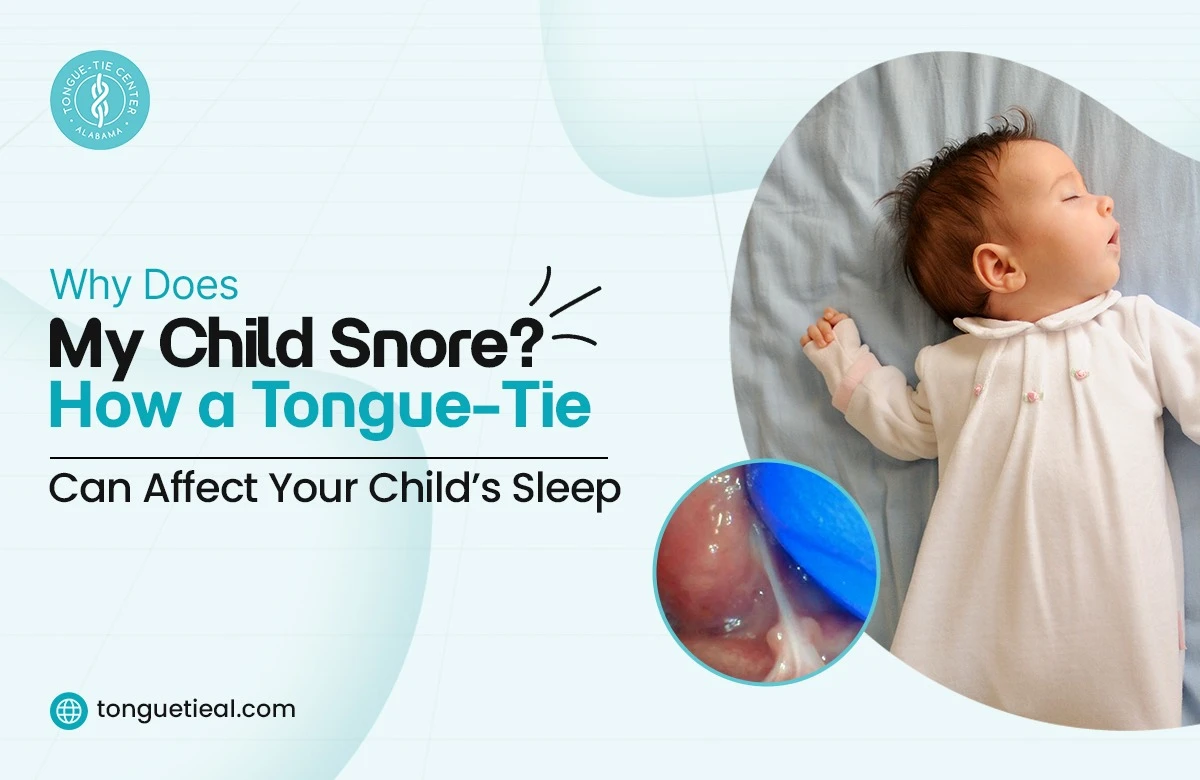
When a tongue-tie holds the tongue down, it can’t rest on the palate. It sits low in the mouth instead. That low tongue posture can lead to a few problems:
- The mouth tends to fall open, so the child breathes through the mouth instead of the nose.
- During sleep, the tongue can fall back toward the throat and narrow the airway.
- Over time, without the tongue supporting it, the palate can grow higher and narrower, which leaves less room for the airway.
When the airway narrows at night, the body fights to keep it open. That can look like snoring, restless sleep, kicking, or grinding the teeth. Grinding is often the body’s way of pushing the jaw forward to open the airway.
Does your child snore?
Find Out If a Tongue-Tie Is Affecting Your Child’s Sleep
Signs Your Child’s Snoring May Be Related to a Tongue-Tie
No single sign proves your child has a tongue-tie. It’s the whole picture that matters. These are the sleep and breathing signs we see most often.
Sleep and Breathing Signs
- Snoring, quiet or loud
- Sleeping with the mouth open
- Mouth breathing during the day
- Restless sleep, kicking, or moving around a lot in bed
- Grinding teeth at night
- Frequent waking or bedwetting
- Waking up tired
Other Tongue-Tie Clues
Kids with a tongue-tie often have other issues too. When I evaluate a child for sleep concerns, I also ask about:
- Feeding trouble as a baby, or slow and picky eating now
- Speech that is delayed or hard to understand
- Crowded teeth or a high, narrow palate
- Thumb sucking or long-term pacifier use
- Frequent ear infections or large tonsils and adenoids
If you’re checking off a lot of these, it’s worth an evaluation. Our quick symptom quiz is a good place to start.
Other Causes of Child Snoring
I want to be clear about this. A tongue-tie is not the only reason kids snore, and a release won’t fix every sleep problem.
Large tonsils and adenoids are a common cause of snoring in children. Allergies, a narrow palate, and other airway issues can play a role too. Often it’s a combination of things, which is why many kids end up seeing several specialists before the full picture comes together.
If you’re worried about sleep apnea, talk with your pediatrician. A sleep study or an ENT evaluation may be needed to know for sure.
Our role is to check whether a tongue-tie or lip-tie is part of the problem. We don’t place orthodontic or airway appliances in our office, but we’re happy to refer you to trusted orthodontists, ENTs, or myofunctional therapists when your child needs more help. You can read more about our approach on our airway dentistry page.
How We Evaluate and Treat Tongue-Tie in Kids With Sleep Issues
Many parents are surprised that a dental office is a good first stop for a snoring child. But because we look closely at the tongue, the palate, and how the mouth works, we often find a restriction that was missed.
The Consult
At your visit, we’ll go over a questionnaire and your child’s history, do a full exam, and take photos if we find a restriction. I’ll check how well your child can lift the tongue, not just stick it out. Less obvious restrictions, like a posterior tongue-tie, are easy to miss if you don’t lift the tongue properly. There’s no pressure, and if I don’t think a tongue-tie is the issue, I’ll tell you.
The Release and Aftercare
If a release is recommended, we can often do it the same day. We use a CO2 laser, and the release takes about 10 to 15 seconds, usually with minimal or no bleeding. No sedation or general anesthesia is needed. Afterward, you’ll do quick stretches three times a day for about 3 to 4 weeks, and we’ll follow up in one week.
When the tongue is free to rest on the palate, sleep often gets better. Parents tell us snoring quiets down, mouth breathing decreases, and their kids wake up with more energy. Every child is different, though, and some kids still need help from other specialists. For children over 4, we often recommend myofunctional therapy to help build good tongue posture and nasal breathing habits.
Frequently Asked Questions
Q1. Is it normal for my child to snore?
Ans. No. Even light snoring in kids can be a sign that the airway isn’t as open as it should be. It’s worth mentioning to your pediatrician and considering an evaluation.
Q2. Can a tongue-tie cause mouth breathing?
Ans. It can. A tongue-tie can keep the tongue resting low in the mouth instead of on the palate, which makes it easier for the mouth to fall open and for a child to breathe through the mouth.
Q3. Why does my child grind their teeth at night?
Ans. Grinding is often linked to poor sleep and breathing issues in kids. The body may push the jaw forward to help open the airway. A tongue-tie is one possible cause we look for, along with other airway issues.
Q4. Will a tongue-tie release fix my child’s snoring?
Ans. Sometimes sleep improves a lot after a release, especially when the tongue was the main problem. But snoring can have several causes, like large tonsils and adenoids, so some kids need care from other specialists too.
Q5. Do you treat older kids for tongue-tie?
Ans. Yes. We treat children from as early as one day old up to age 18. No referral is needed.
Continue Reading
Better Sleep Is Possible
If your child snores, breathes through their mouth, or never seems rested, you’re right to pay attention. You’ve got good instincts. Trust them.
We see families from Birmingham, all over Alabama, and beyond. Our office is at 2480 Pelham Pkwy in Pelham, just south of Birmingham, and we’re open Monday through Friday, 8:00 a.m. to 4:30 p.m. Send us a message or call 205-419-4333 to schedule a consult. We’ll take the time to listen, check your child thoroughly, and help you find the right next steps for better sleep.

Gentle laser tongue-tie and lip-tie care for newborns to age 18. No referral needed.